If you want to get into the IT field, then you need to know how to configure a router and the basic concepts of networking. In this guide, we will focus on the CCNA exam preparation. CCNA stands for Cisco Certified Network Associate.
This is a guide for those who want to get into the IT field and are considering CCNA as their first step.
The CCNA training course has been designed by Cisco as an introductory course for those who want to learn about networking in general and CCNA specifically. The course covers all key topics from a technical perspective which will help them understand what they need to know before moving on with their career in IT.
A CCNA training course can help you get more out of your career as an IT professional because it will teach you how to use the internet, wireless networks, routers and switches to help your company or organization efficiently manage and run its network.
Best CCNA Training:
PyNet Labs is the best CCNA training institute in the world. Our course is unique among all other CCNA training institutes because we offer a unique combination of high-quality technical training and hands-on lab work.
The CCNA course by PyNet Labs covers the following topics:
Networking Fundamentals
Network Access
IP Connectivity
IP Addressing
IP Services
Security Fundamentals
Automation
Programmability
Routing & Switching Technology functions
Installation, Configuration, Operation, Administration, & Troubleshooting Fundamental IPv4 & IPv6 Business Networks
Once you have completed the CCNA Training, you become eligible for entry-level jobs in the networking domain. You can also opt for the CCNA certification exam if you want to get certified with one of the most demanded Cisco certifications.
CCNA Certification is also one of the most important certificates for many enterprises that are looking to fill these roles:
Network Engineer
Network Administrator
IT Support
Help Desk Support, etc.
The average salary for a CCNA-certified person varies from place to place and country to country. In India, you can easily get a package from 3 to 6 LPA with CCNA.
Is CCNA Certification Important?
CCNA Certification is often considered an important certification to enter the networking field, but that is nothing more than a Myth. One can easily get a good networking job with just CCNA knowledge without the certification. PyNet Labs have already placed many freshers at some of the most reputed after completing their CCNA training.
So, no, CCNA certification isn’t that important. What’s important is to have good CCNA knowledge, communication skills, and, most importantly, practical knowledge. Therefore, PyNet Labs focuses on all these skills in their 100% Job Guarantee Programs.
At last, we hope you have a good understanding of CCNA training and CCNA certification. You can also visit PyNet Labs‘ website for more information on networking training.
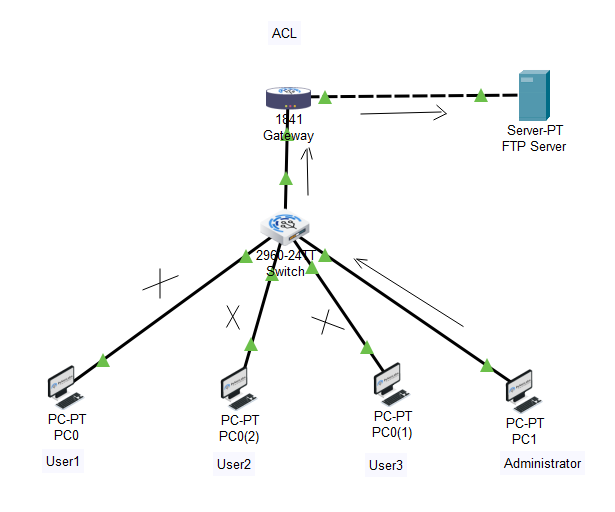
You might also additionally have heard approximately the Access Control List or ACL. It is used to govern permissions to a pcgadget or community, however, do you understandwhat's Access manage list is?
As we know,
the Internet is a community of networks, and routers play a crucialposition in having connectivity amongexclusive networks. Routers are utilized in industries, universities, businesses, company offices, schools, colleges, etc., to attach their exclusive branches from exclusive locations. As a router sends visitors from one community to another, now and again we want to display and manage these visitors for protection purposes. So, we use ACLs, i.e., Access Control
List, to govern and display these visitors. So, let's recognizewhat's Access manage list.
What is Access Control List?
ACLs are policiesdescribed for controlling communityvisitors to lessencommunity attacks. Using a hard and fast of policiesunique for the community's incoming or outgoing visitors, ACLs clear out these visitors.
Using an ACL
is mostlymeant to stable your community. Without it, any visitorsis permitted to bothinput or go out to the community.
Access manipulation lists are hired on pc networks to forbid or allowspecificcommunityvisitors. They clear out the visitors on the premise of the visitors’starting place and destination. In the present day times, Network interfaces and working systems, like Linux and Windows, also areready with ACLs.
A person or organization of users' names makeup one or extraget entry tomanipulate entries (ACEs) which are contained insideevery ACL. The get entry to privileges are unique for everyperson, organization, or position in a string of bits referred to as a get entry to mask.
The character who creates the get entry tomanipulatethe listing for an object is regularly the device administrator or the item owner. Now that you have a higherconceptof whatgets entry tomanipulatelisting, it's time to apprehend its purpose.
What is the purpose of Access Control List?
ACLs or Access control Lists can be used for two purposes, namely:
To filter traffic
To identify traffic
As mentioned above, access lists are a set of rules organized in a rule table. A condition, either permit or deny, is provided by each rule or line in an access list.
When an access list is used to filter the traffic -
a permit statement is used to "allow" traffic,
Whereas, to "block" traffic, a deny statement is used.
In a similar way, when identifying traffic with an access list -
a permit statement is used to include traffic
A deny statement, on the other hand, makes it clear that the traffic should "not" be included.
We hope you have a better understanding of what is the purpose of the Access control list. Moving on, let's see the types of Access Control List.
Types of Access Control List in Networking
Two common types of named access lists are available.
1. Standard Access list
These Access-lists were created solely utilizing the source IP address. These ACLs either allow or disallow the whole set of protocols. There is no distinguishing between the IP traffic like TCP, UDP, HTTPS, etc. Using numbers 1-99 or 1300-1999; the router will recognize it as a standard ACL and the provided address as the source IP address.
IP standard access list -
1–99 (normal range)
1300-1999 (Expanded Range)
2. Extended Access list
This ACL makes use of source IP, destination IP, source port, and destination port. With these ACL types, we can also mention which IP traffic should be allowed or denied. These use range from 100-199 and 2000-2699.
IP extended access list -
100-199 (normal range)
2000-2699 (Expanded Range)
These are the two types of ACL. Let's also take a look at categories of Access lists.
Numbered and named access lists are the two types available.
1. Numbered access-list
These are the access list that cannot be modified when created, i.e., if we want to remove any rule from an Access-list, then this is not allowed in the case of the numbered access list. The whole access list gets deleted if we try to delete a rule from the access list. Both standard and extended access lists can use the numbered access list.
2. Named access list
An access list is given a name in this kind of access list so that it may be recognized. It is allowed to modify a named access list, unlike numbered access list. Like numbered access lists, these can also be used with both standards and extended access lists.
If you are still with us, you have seen most of the important aspects of ACL, such as What is Access Control List, what are the types of Access Control List in networking, and their purpose. Now, spare a few more minutes and check out these essential in-depth insights on ACL.
Important rules to understand ACL
Filtering traffic is the primary use of access lists, so when filtering traffic, access lists are applied on interfaces. A packet travels through a router, which checks the top line of the rule list first before moving down the list until a match is found.
Once a match is made, the packet is either permitted or denied.
All access lists have an implied "deny all" at the end.
Either inbound (packets received on an interface before routing) or outgoing (packets leaving an interface after routing), access lists are applied.
Per interface, protocol, and direction, a single access list is permitted.
In general, standard Access-list is used near the target (but not always).
Typically, an extended Access-list is used near the source (but not always).
If we are utilising a numbered Access-list, we are unable to remove a rule from it. The entire ACL will be erased if we attempt to remove a rule. If we use named access lists, we can delete a specific rule.
Before adopting access lists, thoroughly analyse the entire scenario because every new rule that is added will be placed at the bottom of the access list.
Since every access list contains an implicit deny at the conclusion, we need to include a permit statement in our Access-list at the very least to avoid blocking all traffic.
The names of standard and extended access lists must be different.